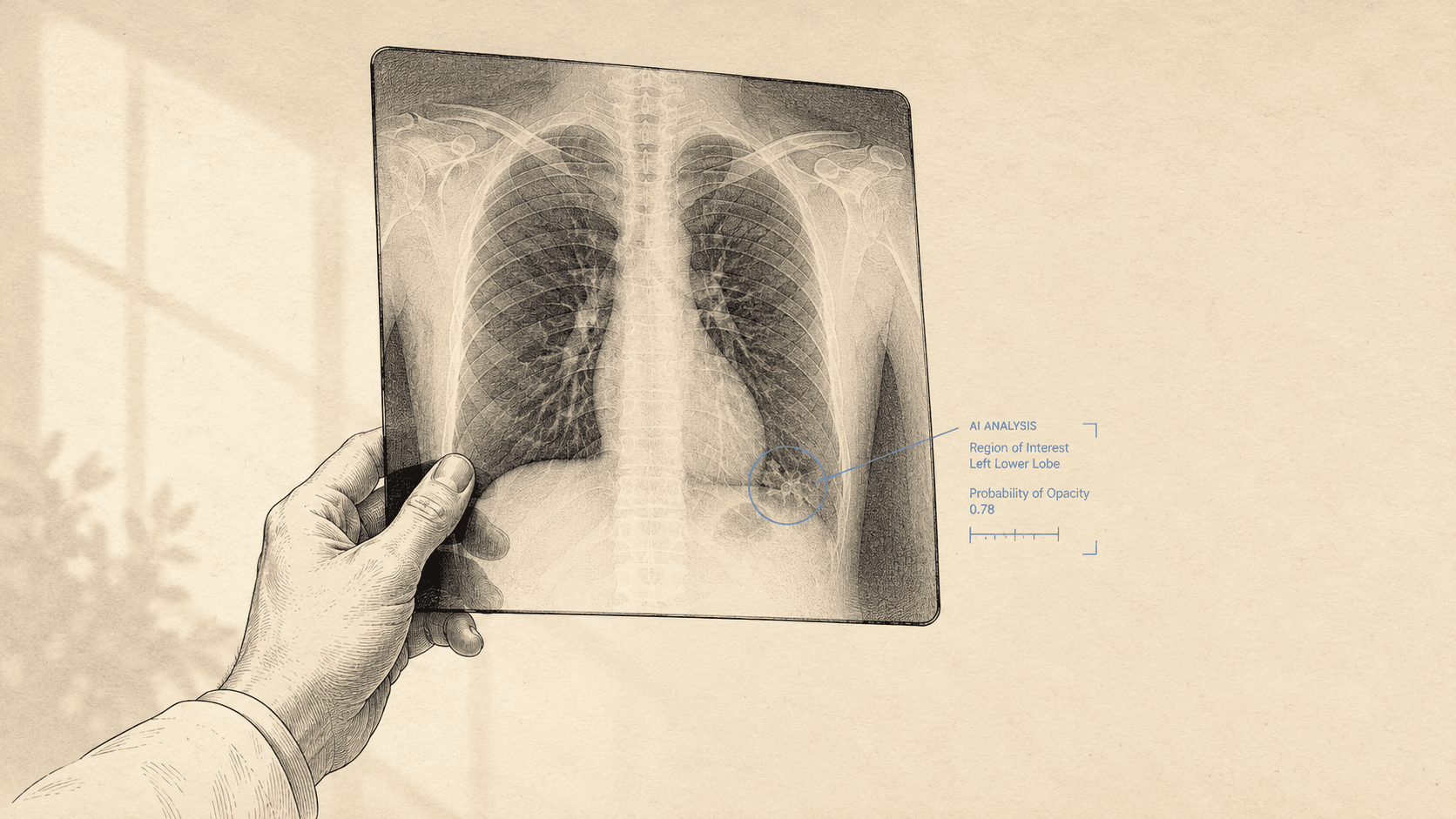
TL;DR: the shortlist for radiology AI in 2026
Radiology AI consolidated faster in the last 18 months than in the prior decade combined. RadNet's Gleamer acquisition in March 2026 turned DeepHealth into the largest pure-play radiology AI vendor by deployed sites. HeartFlow filed for an IPO after CMS finalized CPT 75577 reimbursement for AI-driven CCTA analysis in January 2026. Foundation-model platforms like Aidoc's CARE1 are starting to absorb the single-pathology vendor stack. The field is no longer "which algorithm is best at one finding". The field is which platform a CMIO can sign a five-year contract with.
We aggregated public reviews from clinicians on r/Radiology, Doximity, KLAS commentary, and AuntMinnie; cross-checked vendor documentation and FDA 510(k) databases; and signed off through a board-certified physician on our editorial team. Four picks survived the cut for the use cases below.
Best for acute-care triage: Aidoc. 31+ FDA clearances, 1,000+ US hospital sites, and the CARE1 foundation model now powers cross-pathology workflows that single-finding vendors cannot match.
Best for stroke and cardio coordination: Viz.ai. 1,700+ hospitals, 50+ FDA clearances, and the only platform with a vendor-built care-team coordination layer instead of a bolt-on PACS overlay.
Best global portfolio after the Gleamer acquisition: DeepHealth. RadNet-owned, absorbed Gleamer (musculoskeletal) and iCAD (mammography), and projected to hit $140M ARR in FY2026.
Best reimbursable CCTA AI: HeartFlow. The only platform whose core service maps to a reimbursable CPT code (75577, effective January 2026). The economics changed overnight.
Methodology framing: We did not run hands-on clinical deployments. We aggregated public reviews from radiologists, cross-checked the FDA 510(k) database, reviewed vendor documentation, and signed off through a board-certified physician on our editorial team. See our [full methodology](https://healthcareai.brainbyt.es/methodology) for source weights.
How we evaluated 12 AI radiology platforms
Radiology AI evaluation is harder than scribe evaluation. Most tools don't have public pricing, public-facing reviews are sparse outside KLAS and AuntMinnie, and vendor-stability signals matter more because integration takes 6 to 18 months. We applied the same six-source evaluation we use across the hub, with weights tuned for this category:
FDA 510(k) and De Novo database (25%): clearance count, dates, and indication breadth as a hard floor for "is this clinically usable in the US?"
Vendor documentation (25%): pricing model, integration disclosures, security attestations.
Hospital adoption signals (20%): site counts, named health-system case studies, KLAS commentary.
Peer-reviewed literature (15%): PubMed-indexed prospective studies, not vendor whitepapers.
Clinician community sentiment (10%): r/Radiology, AuntMinnie forums, Doximity threads.
Vendor stability (5%): funding rounds, acquisitions, leadership tenure, and post-acquisition product roadmap clarity.
We excluded any platform that has no published FDA clearance and no documented enterprise deployment outside academic pilots. That cut roughly 40 vendors from a longer working list. The 12 below cleared the floor.
Best for acute-care triage: Aidoc
Aidoc is the default acute-care radiology AI for US health systems with significant trauma or stroke volume. Founded in Tel Aviv in 2016, the company holds 31+ FDA 510(k) clearances across head CT, chest CT, abdominal CT, and CXR, and is deployed across 1,000+ US hospital sites including five of the top ten US Health Systems by net patient revenue. The aiOS platform sits between modality output and PACS, flagging high-acuity findings (ICH, PE, LVO, C-spine fracture, aortic dissection) for radiologist worklist re-ordering inside seconds of acquisition.
The platform's real differentiator in 2026 is CARE1, Aidoc's clinical foundation model. CARE1 is the first deployed radiology foundation model trained on the platform's 30M+ aggregated cross-institutional studies, and it is the underlying inference engine behind multiple of Aidoc's newer clearances. Single-pathology vendors that previously sold one-finding boxes are now competing against a foundation model that updates across all pathologies at once. That is a structurally different competitive shape than it was in 2024.
Aidoc raised a $150M Series E in late 2025 (per the company's own disclosure) and reported ARR run-rate north of $100M in aggregated press coverage from AuntMinnie and HIT Consultant. Pricing is enterprise-only and module-based, typically starting around $50K per site per year for the first module and scaling with study volume and module count. There is no self-service entry point and no published per-study pricing.
Pros
31+ FDA 510(k) clearances. Largest pure-radiology clearance count after the OEM suites.
1,000+ US hospital sites including high-acuity trauma centers and academic medical centers.
CARE1 foundation model architecture means new pathology indications ship without rebuilding from scratch.
Native integration with major PACS vendors (Sectra, Visage, Change Healthcare, Philips).
Vendor stability is the strongest among the pure-play startups (post Series E, $100M+ ARR run-rate).
Cons
Enterprise-only pricing. No self-service for outpatient imaging centers.
Module-based pricing can stack: a hospital wanting six pathologies pays meaningfully more than one wanting two.
Cardiac coverage is lighter than Viz.ai or HeartFlow. Aidoc is acute-care first.
Best for: Health systems with high-acuity ED and stroke volume, an existing PACS contract, and a CMIO or imaging director ready to commit to a multi-module rollout.
Best for stroke and cardio coordination: Viz.ai
Viz.ai is the platform you pick when the bottleneck is not the radiologist's worklist but the care team. Founded in 2016, headquartered in San Francisco, and live in 1,700+ US hospitals as of 2026, Viz.ai built the only AI radiology platform with a vendor-native care-coordination layer. When the LVO algorithm flags a stroke, the platform notifies the neurology and interventional teams directly on mobile, with the relevant imaging attached, before the radiologist's final read. For stroke programs running DAWN or DEFUSE-3 windows, that minute-saving is the entire product thesis.
The platform now extends well past stroke. Viz.ai holds 50+ FDA clearances across stroke, pulmonary embolism, aortic dissection, right-heart strain, and HCM screening. The cardio expansion (Viz HCM, Viz RV/LV) followed the company's 2024 acquisition of Cathworks and its $100M Series E. KLAS commentary aggregated in early 2026 places Viz.ai consistently in the top quartile for care-coordination workflow satisfaction, though radiologist-only satisfaction (separated from care-team satisfaction) sits closer to the middle of the pack.
The structural read on Viz.ai is that it is less of a radiology AI vendor and more of a clinical event-bus that happens to consume imaging AI. Hospitals adopting it for stroke often later expand to PE and cardio because the coordination infrastructure is already deployed.
Pros
1,700+ US hospital deployments. Largest deployed footprint of any pure-play radiology AI vendor.
50+ FDA clearances across neurovascular, vascular, and cardiac indications.
Care-coordination layer is vendor-native, not a third-party integration. Genuinely differentiated.
Mobile-first notification flow that reaches clinicians outside the radiology reading room.
HIPAA, SOC2 Type II, and HITRUST attestations published on the vendor site.
Cons
Radiologist-only review workflow is thinner than the foundation-model platforms.
Per-site enterprise subscription pricing, often higher than per-module pricing of competitors for narrow use cases.
Stroke and cardio focus means lower coverage of routine outpatient imaging (mammography, MSK, abdominal).
Best for: High-volume stroke centers, advanced PE programs, and cardiology programs where care-team coordination latency is the operational bottleneck.
Best global portfolio after the Gleamer acquisition: DeepHealth
DeepHealth is what happens when an operator (RadNet, the largest US outpatient imaging chain) decides to own its AI vendor instead of renting it. RadNet acquired DeepHealth in 2020 for mammography, absorbed iCAD's cancer-detection portfolio in 2024, and in March 2026 closed the acquisition of Gleamer, the French musculoskeletal AI vendor with strong EU NHS and SS deployments. The result, as of 2026, is the world's largest deployed radiology AI portfolio by combined site count, covering mammography, MSK, chest, and reporting workflow across the US and EU.
The combined entity is projected to reach $140M ARR in FY2026 (per RadNet investor disclosures), making DeepHealth the only pure-play radiology AI vendor publicly tracked through a NYSE-listed parent. That visibility matters: vendor-stability risk is meaningfully lower than for venture-funded startups, and RadNet's own 350+ imaging centers serve as a continuous validation deployment for new models before they ship to third-party hospitals.
The trade-off, in aggregated reviews from radiology informatics communities, is that DeepHealth's product line is less of a unified platform than Aidoc's CARE1 or Viz.ai's coordination layer. Mammography (formerly DeepHealth Saige), MSK (formerly Gleamer BoneView), and chest workflow operate as adjacent products inside a portfolio, not as a single foundation model. For health systems that want one vendor relationship across multiple modalities, the portfolio breadth wins. For health systems that want a unified inference engine, Aidoc still has the architectural edge.
Pros
Largest combined deployed footprint after the Gleamer acquisition (US + EU).
Operator-owned (RadNet) means continuous in-house validation across 350+ imaging centers.
$140M projected FY2026 ARR through a NYSE-listed parent: lowest vendor-stability risk in the category.
Mammography and MSK coverage is among the deepest in the market post-acquisition.
Strong EU regulatory posture inherited from Gleamer (CE-IVDR, MDR).
Cons
Product portfolio is not yet unified into a single foundation-model platform.
Sales motion still adapting post-acquisition: integration timelines reported as inconsistent across the three legacy product lines.
Cardiac coverage is the weakest among the four picks. Hospitals with significant cardiac volume should pair with HeartFlow or Cleerly.
Best for: Multi-modality imaging operators (outpatient chains, multi-site hospital systems) that want one vendor relationship across mammography, MSK, and chest, with EU + US regulatory coverage.
Read the full DeepHealth review →
Best reimbursable CCTA AI: HeartFlow
HeartFlow is the only platform on this list whose core service maps to a reimbursable CPT code. CMS finalized CPT 75577 (AI-driven FFR-CT analysis) for the 2026 Medicare Physician Fee Schedule in January 2026, with a national average payment in the $930 to $1,050 range per study depending on facility setting. That single regulatory change turned HeartFlow from an enterprise-sale value proposition into a per-study line item that imaging centers and cardiology practices can model directly into their revenue.
The clinical premise has been validated for years. HeartFlow's FFR-CT analysis (non-invasive computed FFR from CCTA imaging) is supported by the FDA De Novo clearance, multiple prospective trials including PLATFORM and ADVANCE Registry, and inclusion in 2021 ACC/AHA chest pain guidelines as a Class IIa recommendation. What changed in 2026 is the economics. HeartFlow filed for an IPO in Q1 2026, and per-study pricing now slots cleanly under the new CPT.
The product has also expanded past FFR-CT into a broader plaque-analysis suite (HeartFlow Plaque Analysis, cleared 2023; HeartFlow RoadMap Analysis, cleared 2024) that competes more directly with Cleerly, the venture-funded plaque-analysis competitor. Cleerly is well-positioned clinically but does not have the reimbursement footprint that HeartFlow secured with the 2026 CPT decision.
Pros
Only platform on this list with a reimbursable CPT code (75577, effective Jan 2026).
FDA De Novo clearance for FFR-CT plus 510(k)s for plaque analysis and RoadMap.
Strongest peer-reviewed evidence base in the category (PLATFORM, ADVANCE, multiple substudies).
ACC/AHA 2021 chest pain guideline inclusion (Class IIa).
Imminent IPO (filed Q1 2026) means audited financials and lower vendor-stability risk.
Cons
Single use case (CCTA-derived FFR and plaque). Not a general radiology platform.
Per-study pricing only economically attractive for cardiology and dedicated cardiac imaging programs.
Turnaround time for FFR-CT analysis (historically hours, not minutes) remains slower than in-modality AI competitors.
Best for: Cardiology practices and dedicated cardiac imaging programs that bill CCTA volume and now want to capture the new CPT 75577 reimbursement.
Read the full HeartFlow review →
What to look for: 5-criteria buyer's guide
Criterion 1: FDA clearance breadth vs depth
A 510(k) clearance count is a floor, not a ceiling. Aidoc's 31+ clearances span ED-acute pathologies across multiple body regions; that breadth matters if your bottleneck is ED throughput. GE HealthCare publishes 120+ AI clearances across the suite, but most are tied to specific GE modalities and don't function on third-party hardware. Treat the number as a starting filter, then read the actual indications. A platform with five clearances perfectly aligned to your case mix beats a platform with fifty clearances aligned to someone else's.
Criterion 2: Workflow integration and PACS posture
Three architectural patterns dominate in 2026: vendor-native (Aidoc aiOS, DeepHealth platform), care-coordination overlay (Viz.ai), and OEM-bundled (GE, Siemens, Philips, Canon, United Imaging). Vendor-native gives you cross-modality reach but requires a PACS contract that supports it. Care-coordination overlays reach beyond radiology into the ED and cath lab. OEM-bundled is the lowest integration friction if your modality fleet is single-vendor, but it locks future AI choices to that OEM. Pick the pattern before you pick the vendor.
Criterion 3: Reimbursement and economic model
For most radiology AI, there is no reimbursement. The economic model is per-site enterprise subscription, and ROI lives in throughput or quality metrics. The exception, as of January 2026, is CCTA AI via CPT 75577, where HeartFlow and increasingly Cleerly can be modeled as line-item revenue. Mammography AI has a partial reimbursement path through breast-density follow-up and supplemental imaging codes, but it is not a clean AI-specific CPT. Be honest with finance about which bucket your evaluation falls into.
Criterion 4: Specialty and case-mix fit
The four picks above each serve a different center of gravity. Aidoc is acute-care first. Viz.ai is stroke and cardio coordination first. DeepHealth is portfolio-breadth first (mammography, MSK, chest). HeartFlow is single-use-case first (CCTA). Single-pathology specialists (Cleerly for plaque, Lunit for CXR/MMG, Annalise.ai for multi-finding CXR + brain CT, Qure.ai for global TB and head CT) outperform the platforms on their narrow indication but require you to manage a multi-vendor stack.
Criterion 5: Vendor stability after the 2024-2026 consolidation wave
Half of the standalone radiology AI vendors that existed in 2022 are now inside a larger entity. Nuance is inside Microsoft. Gleamer and iCAD are inside DeepHealth (RadNet). Arterys is inside Tempus. Cathworks is inside Viz.ai. The remaining standalone players (Aidoc, Viz.ai, Rad AI, RapidAI, Qure.ai, Cleerly, HeartFlow) have all either raised late-stage rounds or filed to go public. Single-product startups without a foundation-model platform or a reimbursement path are the highest vendor-stability risk in the category. Underwrite accordingly.
How the field has shifted in 2026
Three structural shifts define the radiology AI market in 2026, and they map directly to how you should sequence vendor evaluation.
First, foundation models are absorbing single-pathology vendors. Aidoc's CARE1, announced in late 2025 and live in early 2026, is the clearest example. The architecture means new clearances ship as fine-tunes on a unified inference base, not as new product builds. Health systems running five different single-pathology AI vendors today will, by 2027, mostly be running one platform with five clearances.
Second, vendor consolidation has compressed the field. RadNet's March 2026 acquisition of Gleamer for an undisclosed amount (estimated $150M+ per industry coverage) made DeepHealth the largest deployed AI portfolio in the world. Tempus absorbed Arterys in 2023. Microsoft owns Nuance. The OEMs (GE HealthCare with 120+ clearances, Siemens, Philips, Canon, United Imaging) continue to bundle. Standalone startups outside the top quartile of funding now face structural disadvantage.
Third, reimbursement is finally a real lever, but only in one corner of the market. CMS finalized CPT 75577 for AI-driven FFR-CT in January 2026. HeartFlow filed for an IPO the same quarter. Mammography AI has a partial reimbursement path through density-screening codes. The rest of the market still sells on enterprise subscription, with ROI modeled through throughput and quality metrics rather than line-item billing. Expect 2027 to bring additional AI-specific CPTs (the AMA RUC pipeline already includes proposals for ICH triage and PE detection), but do not underwrite a 2026 purchase against a 2027 CPT that has not yet been finalized.
Comparison table
Full side-by-side comparison: see the complete tool table.
Honorable mentions also reviewed but not picked: Siemens Healthineers AI-Rad Companion, Philips Imaging AI, Canon Medical AI, United Imaging uAI, Kheiron Mia (NHS-strong mammography), Behold.ai (UK CXR triage), and Subtle Medical (dose-reduction image enhancement).
Frequently asked questions
Does any AI radiology platform actually reduce radiologist read time, or just add another worklist?
In aggregated review of published studies and clinician sentiment, the honest answer is "depends on the indication". For high-prevalence acute findings (ICH, LVO, PE) triage AI like Aidoc and Viz.ai consistently shows door-to-treatment time reductions in published data. For routine outpatient reads, productivity gains are smaller and sometimes negative when the AI adds confirmation overhead. Read the indication-specific evidence, not the platform-level marketing.
Is the FDA clearance count a real differentiator or vendor marketing?
It is both. The count is real (the 510(k) database is public and verifiable), but raw counts conflate breadth with depth. A platform with 30 narrow clearances on a single anatomy is not equivalent to a platform with 30 cross-anatomy clearances. For evaluation, pull the actual indications for use from the FDA database and map them against your case mix. Ignore the marketing number.
What changed with CPT 75577 for CCTA AI in January 2026?
CMS finalized CPT 75577 as a separately reimbursable code for AI-driven FFR-CT analysis in the 2026 Medicare Physician Fee Schedule. National average payment lands in the $930 to $1,050 per-study range depending on facility setting. This is the first cleanly AI-specific CPT in radiology and changes the economics of CCTA AI from "ROI through throughput" to "line-item revenue". HeartFlow is the primary beneficiary, with Cleerly and other CCTA plaque vendors increasingly positioning to capture the same code.
How worried should I be about vendor consolidation risk?
Worried enough to ask the question, not worried enough to delay a purchase. The 2024-2026 consolidation wave (Microsoft + Nuance, RadNet + Gleamer + iCAD, Tempus + Arterys, Viz.ai + Cathworks) has actually reduced vendor-stability risk for the surviving platforms by giving them parent-company balance sheets. The real risk now lives with the single-product startups that did not consolidate and did not raise late-stage funding. Underwrite vendor stability as 5-10% of your evaluation weight, not 50%.
Can we run AI from multiple vendors simultaneously, or does one platform lock out others?
Architecturally, multi-vendor stacks are common. Most US health systems run two to four AI vendors today (a triage platform, a single-pathology specialist or two, and an OEM-bundled suite). The friction is integration cost (each vendor wants its own PACS hook and worklist surface) and workflow cohesion (radiologists toggling between three UIs). Foundation-model platforms like Aidoc's CARE1 reduce the multi-vendor incentive over time because new pathologies ship as updates to the existing platform rather than as separate vendor relationships.
What is the right starting point for a hospital evaluating AI radiology for the first time?
Pick one bottleneck and one vendor. The two highest-yield starting points in 2026 are: (a) acute-care triage with Aidoc if your bottleneck is ED throughput and time-critical findings; (b) stroke coordination with Viz.ai if your bottleneck is door-to-needle or door-to-puncture time. Both have the deployment volume and KLAS history to support a first contract without serving as the guinea pig. Multi-modality platform plays come later.
Related reading on Healthcare AI Hub
Methodology and disclosure
This article aggregates public reviews from radiologists on r/Radiology, AuntMinnie, and Doximity; cross-checks the FDA 510(k) and De Novo databases, peer-reviewed literature on PubMed, and vendor documentation; and is signed off by our board-certified physician advisor. None of the platforms reviewed in this post operate affiliate programs. This silo earns no commission on outbound links and is published as topical-authority and clinician-reference content. Full editorial policy at /methodology.