
- Contact for pricing
- Attested
- Type II
- 3
- 2018
- US
AI medical scribes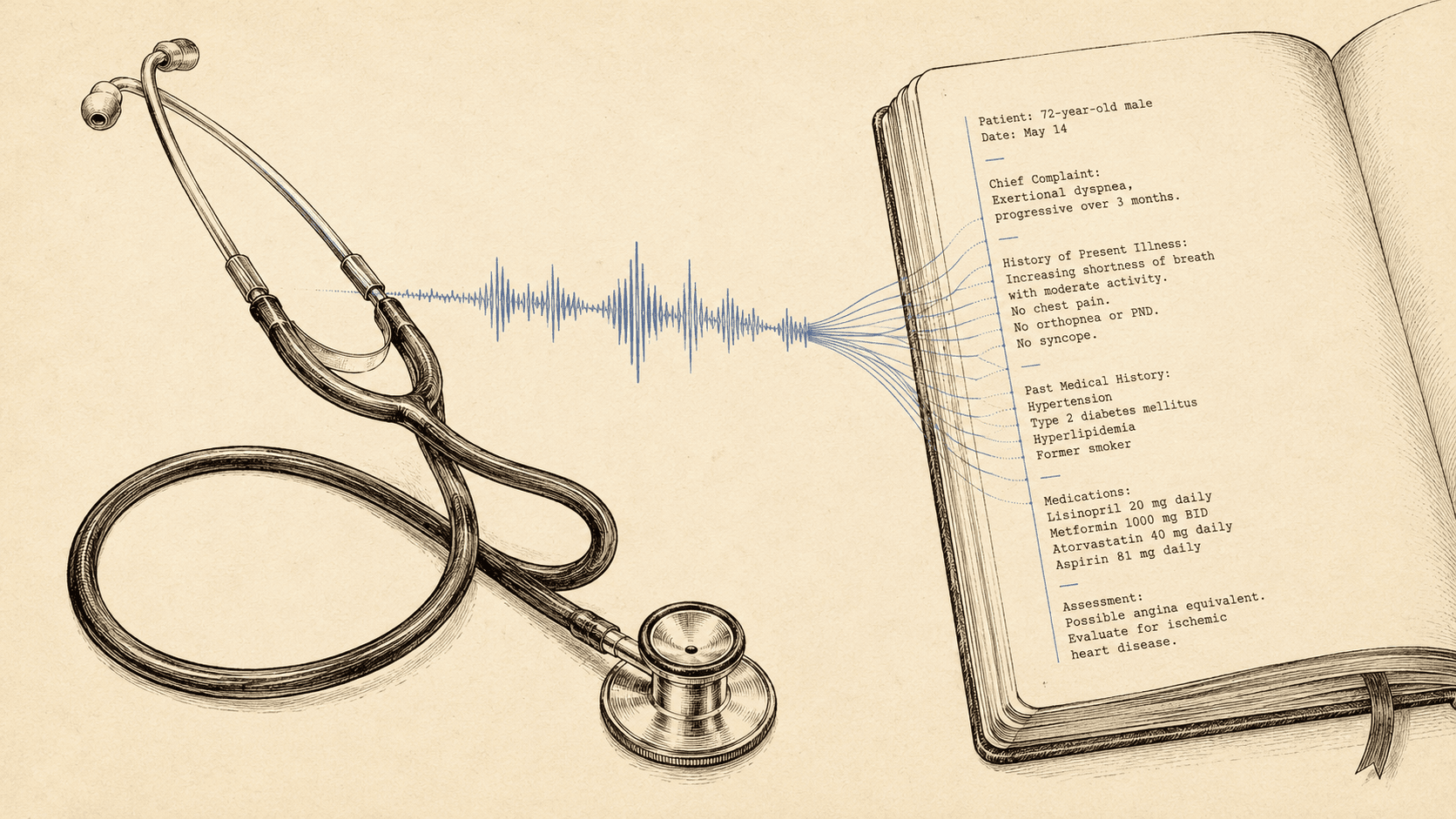
Abridge
by Abridge AI Inc. · founded 2018 · US
Enterprise ambient scribe with Linked Evidence traceability.
On this page
56/100Solid choice
- Regulatory & Compliance13/25
HIPAA + (SOC2 or BAA) attested
- Clinical Integration18.3/38.2
Epic + Oracle Cerner + Athena
- Evidence Strength4.9/10
4 peer-reviewed papers
- Vendor & Market18/18
Top-tier funding and adoption
- Sentiment & Transparency4.9/14
Sentiment 55/100 across 22 mentions
▸ Show all 11 dimensions▾ Hide dimension detail
- FDA clearance0/12
No FDA clearance listed
- HIPAA / SOC2 / BAA13/13
HIPAA + (SOC2 or BAA) attested
- EHR integrations (count)6/21
3 EHR integrations
- Top-3 EHR coverage (Epic / Oracle / Athena)12/12
Epic + Oracle Cerner + Athena
- Bidirectional write-back0/5
No bidirectional write-back documented
- Peer-reviewed papers5/7
4 peer-reviewed papers
- RCT / meta-analysis / systematic review0/3
No RCT, meta-analysis, or systematic review
- Funding & adoption signal12/12
Top-tier funding and adoption
- Years in market6/6
Founded 2018 (8 years)
- Clinician sentiment (Reddit)5/9
Sentiment 55/100 across 22 mentions
- Pricing transparency0/5
No public pricing
Deepest EHR integrations + the strongest vendor-stability story.
$458M+ funding, Yale and UPMC adoption announcements, consistently the highest note-quality ratings across clinician reviews. No public price: third-party estimates run about $208 to $600 per provider per month as of October 2026.
Bottom line
Abridge is an enterprise ambient scribe built around Epic. It converts the patient conversation into a structured note and maps note statements back to the transcript and audio. Priced by quote only, it is bought by institutions, not by individual physicians. Independent evidence for Abridge by itself is thin: the best studies pool several vendors, and the Reddit threads that name it are mostly neutral, and the two critical ones are about note quality. It suits a health system on Epic with an implementation team and a budget. A solo practitioner, or a clinic that wants a public price and a trial, should look at the self-serve scribes instead.
Abridge pricing in 2026: what it actually costs
Abridge publishes no price: abridge.com has no pricing page and /pricing returns a 404 (as of October 2026). Third-party estimates run roughly $208 to $600 per clinician per month, with about $2,500 per year as the most repeated baseline, plus implementation. It is enterprise sales only.
What is not in the Abridge list price?
abridge.com has no pricing page, only "Contact Us" and an impact calculator, and /pricing returns a 404. There is no self-serve plan and no public trial.
Third parties supply estimates, and several sell competing scribes. About $2,500 per clinician per year, or about $208 per month, is the baseline repeated by two review sites. An RFP.wiki collection gives $2,500 to $7,200 or more per clinician per year before implementation. Other sources say $300 to $600 per clinician per month for full deployments and $400 to $600 with deep EHR integration and multi-year terms. Keragon puts enterprise scribes, including Abridge, at $250 to $900 or more per provider per month, and says implementation takes 3 to 6 months. Health-system deals typically run six to seven figures a year, per a roundup.
Abridge was named Best in KLAS for Ambient AI in 2025 and 2026, as reported by third parties, and we found no KLAS per-provider price. Abridge lists HIPAA, SOC 2 Type II, Epic, Cerner and Athena integrations, and Linked Evidence traceability.
Is Abridge worth it?
Abridge suits a large Epic health system with a rollout team and a competitive procurement process. A small practice can look at Freed, which lists self-serve prices. Our Abridge pricing post has the full source list.
Verified October 14, 2026 from abridge.com.
What is Abridge and who sells it?
Abridge describes its product as AI-powered clinical documentation "built for accuracy", organised into three experiences (clinicians, revenue cycle, nursing) plus an Assistant and a module called Care Signals (Abridge website, read October 2026). The core function is ambient documentation: it listens to a visit and drafts the note.
The company is Abridge AI, Inc., based in Pittsburgh. It was founded in 2018 by Shivdev Rao, a cardiologist who is CEO, with Florian Metze and Sandeep Konam, and it grew out of the Pittsburgh Health Data Alliance of the University of Pittsburgh, UPMC and Carnegie Mellon (Contrary Research).
Funding is large and the press figures disagree in places. TechCrunch reported a $250M Series D in February 2025 at $2.75B and a $300M Series E in June 2025 at $5.3B, led by Andreessen Horowitz with Khosla. Sacra reports a further $316M extension in April 2026, while Tracxn dates a $316M round to June 2025. Total funding is quoted between $758M and $830M depending on the source. No ownership changes are reported. The vendor's page states "Best in KLAS" for ambient AI in 2025 and 2026, which is vendor-presented recognition.
What does Abridge do well?
Its strongest feature is traceability. Abridge calls it Linked Evidence: statements in the note are mapped back to the transcript and audio, so a clinician can check where a line came from (Abridge product page). That is the vendor's description, and it was not tested here. The clinician who signs the note carries the cost of an unchecked error, which is why traceability is the feature to ask about in a demo.
The second strength is Epic depth. TechCrunch describes Abridge as the first Epic "Pal" partner, in August 2023, and the vendor's own press release describes "Abridge Inside" running in Epic from Haiku to Hyperdrive at Emory. If your health system lives in Epic, that integration path is a real reason to shortlist the product.
Breadth is the third. Beyond physician notes, the site lists revenue-cycle documentation, nursing documentation and care-signal modules. Language coverage is stated as 14 or more in an older press release, and an AltaMed deployment announcement cites 28 languages. The two figures reflect different dates and deployments, so we do not give a single number.
The vendor's home page makes these customer claims: UW Health with more than 800 providers and 30 minutes a day of documentation time saved, Inova with 9,400 or more clinicians across 40 or more specialties, and 95% retention at Akron Children's.
On security, the Trust Center lists CCPA, HIPAA, SOC 2 Type 1 and Type 2, and TX-RAMP, with the SOC 2 report available on request (Abridge Trust Center), and a standard Business Associate Agreement is offered on the product page. The Trust Center does not list HITRUST or ISO 27001.
Where does Abridge fall short?
The sharpest criticism comes from working clinicians, and it is about the draft note. A physician on r/medicine (March 2026) called the HPI inaccurate and amateurish, wrote that the note "commonly contains inaccuracies", and said it misses exam findings. On r/emergencymedicine the same month, a physician whose department had just integrated Abridge into Epic and used it through Haiku wrote that they spent more time proofreading and editing than it would take to just write the note.
Two threads do not make a rate. Several other threads are neutral: an emergency department keeping human scribes while Abridge rolls out (October 2025), a department moving to Abridge on Epic asking for pros and cons (May 2026), and a family physician asking which scribe is best among DAX, Abridge, Suno and Vero (December 2025). A family medicine thread from August 2025, "Piloting Abridge, the AI scribe", describes a week of use on Epic with Haiku.
The research literature supports caution in general, not about Abridge specifically. A narrative review reports frequent omissions and occasional clinically significant hallucinations across ambient scribes (PMC12973079). No peer-reviewed accuracy study of Abridge alone is published.
Price is the other gap. There is no public price, and the pricing page lists no plans or trial. Procurement is a sales process, and one roundup describes a 12-month minimum and three to six months to buy. That roundup is third-party and should be read that way.
How does Abridge compare with DAX Copilot, Heidi and the rest?
The comparison set is the one Reddit uses: DAX Copilot (now Microsoft Dragon Copilot), Heidi Health, Suki, Nabla, Ambience, DeepScribe, Commure, Vero Scribe and Freed. In a February 2026 r/healthIT thread, a poster described Abridge as "one of the players in ambulatory care" and wrote that for Heidi "several ppl said it's expensive".
Against DAX Copilot, the contest is about ecosystem. Both are enterprise products sold by quote, and both integrate with Epic. DAX comes from Microsoft with a Nuance heritage and a security white paper that cites a HITRUST-certified Azure environment, while Abridge is a venture-backed specialist. Neither publishes a price. Third-party estimates for Abridge run from about $208 to $600 per clinician per month, plus implementation. DAX estimates run from about $150 to $600 or more. The estimates come from vendors who sell competing scribes, so they show the width of the uncertainty and are not quotes.
Against Heidi, the contest is about buyer type. Heidi publishes a free tier and a trial and suits an individual clinician. Abridge publishes neither. One r/medicine poster in October 2023 noted that Abridge then offered individual licences without EMR integration while warning their institution against buying its own scribe. Whether that individual route still exists is not confirmed.
By situation, Abridge fits when the decision is institutional and Epic is the record. It fits poorly when you need to start this week, pay by card, or see a price before talking to sales.
What does the evidence say about Abridge?
The evidence is partial and not Abridge-specific. The best-known study is a multi-site JAMA analysis of 8,581 clinicians at five health systems using Ambience, DAX or Abridge (reported by Healthcare Dive). It found 13.4 fewer EHR minutes and 16.0 fewer documentation minutes per 8 scheduled hours. After-hours EHR time did not fall significantly overall, and only about 32% of adopters used the scribe in at least half of their visits. It is a multi-vendor result and cannot be credited to Abridge alone.
Two 2025 papers concern ambient tools in practice. An observational study in Digital Health (PMID 41323090) examined changes in EHR documentation metrics after an ambient listening tool was introduced in primary care. A quality-improvement survey in JAMIA Open (PMID 39991073) assessed clinician perspectives on workload, burnout and job satisfaction. Separately, a narrative review (PMC12973079) attributes to a JAMIA Open study from February 2025 (Albrecht et al.) a finding that 73% of Abridge users reported less documentation outside clinical hours. The figure is the review's account of the paper.
Who is Abridge for?
- A CMIO at an Epic health system rolling out ambient documentation to hundreds of clinicians, with a procurement team and a pilot plan, is the intended buyer.
- An emergency department that already has human scribes and is weighing a transition. The two March 2026 threads say to pilot with your own note templates and measure editing time before you commit.
- A nursing or revenue-cycle leader who wants documentation beyond physician notes in the same vendor.
Abridge does not fit a solo practitioner or a two-physician clinic, a clinician outside Epic who needs write-back, which is not documented, or anyone who needs a published price before a first call. Self-serve scribes are cheaper to try.
The verdict
Abridge is a credible enterprise scribe with a documented Epic path. The proof of its benefit is shared across vendors, and the user reports that exist are critical or neutral. Pilot it with your own clinicians, count the minutes they spend editing, and get the price in writing: there is no public list as of October 2026, and third-party estimates of about $208 to $600 per clinician per month plus implementation are not Abridge figures.
Editorial review last generated October 14, 2026. Synthesized from clinician sentiment, peer-reviewed coverage, and our editorial silo picks. Refined by hand where vendor facts change.
What deploys cleanly
Carries HIPAA, SOC2 Type II per vendor documentation. Independent attestation review is the buyer's responsibility before clinical deployment. Integrates with 3 EHRs: Epic, Cerner, Athena.
Who builds it
Abridge (Abridge AI Inc.) was founded in 2018 in US, putting it 8 years into market.
What the literature says
4 peer-reviewed studies indexed on PubMed evaluate Abridge in clinical contexts. The most relevant are shown below, ranked by editorial relevance score combining title match, study design, recency, and journal tier.
- Enhancing clinical documentation with ambient artificial intelligence: a quality improvement survey assessing clinician perspectives on work burden, burnout, and job satisfaction.
- Albrecht M, Shanks D, Shah T, et al.· JAMIA Open· 2025
- This study evaluates the impact of an ambient artificial intelligence (AI) documentation platform on clinicians' perceptions of documentation workflow. An anonymous pre- and non-anonymous post-implementation survey evaluated ambulatory clinician perceptions on impact of Abridge, an ambient AI documentation platform. Outcomes included clinical documentation burden, work after-hours, clinician burnout, and work satisfaction. Data were analyzed using descriptive statistics and proportional odds logistic regression to compare changes for concordant questions across pre- and post-surveys. Covariat…
- Ambient listening implementation in primary care and changes in electronic health record documentation metrics: Pre-post study of an ambient listening tool.
- North F, Matthews MR, Iqbal A, et al.· Digit Health· 2025
- Ambient listening with subsequent artificial intelligence enabled medical record documentation is changing how physicians interact with the electronic health record (EHR). We studied primary care physician use, documentation time, and changes in note metrics associated with ambient listening technology. We calculated the percentage of physicians adopting the ambient listening tool, Abridge. Note input contributed by Abridge was determined by the percentage of total characters in generated notes. Using the Epic EHR Signal metrics, we analyzed the change in note documentation time and note leng…
- Crossover Evaluation of Two Ambient AI Scribe Tools in the Emergency Department.
- Webb J, Chu L, Turer RW, et al.· Appl Clin Inform· 2026
- This study aimed to compare two ambient AI documentation tools, Dragon Ambient eXperience (DAX) and Abridge in the emergency department (ED), assessing perceived effects on work burden, usability, documentation quality, satisfaction, and overall preference.We conducted a single-site, prospective crossover study in an ED over 6 weeks, from April to June 2025. Out of 20 faculty enrolled, 18 completed both phases. Participants used both ambient AI scribe tools in alternating 3-week phases. Pre-tool, tool-specific, and post-tool surveys captured four domains: burden, usability, quality, and satis…
- Linguistic Effects of Ambient AI on Clinical Documentation: A Matched Pre-Post Study.
- Li Y, Zhou H, Blackley S, et al.· medRxiv· 2026
- Ambient intelligence-based systems are increasingly used for clinical documentation. To quantify linguistic differences associated with ambient documentation, we conducted a matched pre-post analysis of 6,026 outpatient clinical notes from Mass General Brigham following implementation of two ambient AI documentation systems (Nuance Dragon Ambient eXperience [DAX] and Abridge). Within-clinician comparisons focused on the History of Present Illness (HPI) and Assessment and Plan (A&P) sections and evaluated syntactic complexity, lexical ambiguity, linguistic variability, discourse coherence, and…
What clinicians say about Abridge
Aggregated from 22 public clinician mentions. We quote with attribution under fair-use commentary.
Aggregated sentiment from 22 public mentions
- mixed
- 18%
- 0.09
- Reddit·22
- note-quality6
- ehr-integration5
- ease-of-use3
- accuracy2
- time-savings2
- billing1
- pricing1
- documentation-time1
- 01chooses diagnoses quite well
- 02has a billing los tool
- 03generates possible orders list
- 04concise hpi with little to no editing
- 05picks up incidental mentions during visit
- 01orders feature is hit or miss
- 02no integration with existing smartphrases for a/p
- 03requires copy-pasting and pruning
- 04requires holding phone during encounters
- 05interferes with rounds writing and physical exams
“Thoughts/experiences working with AI scribes? Hey all! I have no experience with AI scribes myself so I'm asking anyone who's used Abridge, Suki, or DAX: Any thoughts? feedback? experience with these? What are some pros and cons of each?”
“Which AI tool is the best for primary care? (DAX, Abridge, Suno AI, Vero Scribe, etc) I want an AI tool that not only summarizes HPI, but also A/P. I am considering DAX, Abridge, Suno AI, and Vero Scribe. My EMR is Epic, but I also use ECW at some places. Also, is there any AI tool that chooses diagnosis + appropriate billing code? How about sending prescription? Any tools that…”
“Ai in medicine: hype or real help? I don’t buy the whole “AI will replace doctors” narrative. What I’ve actually seen? AI taking care of the tedious stuff, notes, flags, reminders, so doctors can focus on patients. Have you seen AI actually make your job easier? any thoughts on: [OrbVoice](https://apps.apple.com/us/app/orbvoice-medical-ai-scribe/id6503405426), Abridge and other…”
Summarized from 22 public clinician mentions. We quote with attribution under fair-use commentary and never republish full reviews. See our editorial methodology for source weights.
Other ai medical scribes
See the full ai medical scribes ranking
DAX Copilot
by Microsoft (Nuance)
Microsoft-backed ambient scribe with deepest EHR embed.
$369/mo|HIPAA / SOC2 Type IIEpic AI Charting
by Epic Systems
Epic's native ambient note drafting in the Haiku and Canto apps. Also called Chart with Art (general availability 4 February 2026).
Contact for pricingHeidi Health
by Heidi Health
Multi-output ambient scribe, 110+ languages, UK/AU strong.
$110/mo|HIPAA / GDPR
Nabla
by Nabla
Clinical AI layer for health systems: ambient documentation, dictation and coding suggestions, plus the Nabla Connect API for partners.
No public price: nabla.com/pricing returns a 404 page with a contact form. Terms of Sale state a monthly fee per authorized user, in euros excluding VAT.|HIPAA / GDPR
Common questions about Abridge
Answers below cover the most-searched clinician questions for Abridge in 2026. Updated as vendor docs and pricing change.
Articles mentioning Abridge
Suki pricing in 2026: what practices and health systems actually pay
Suki publishes no price. Third parties report $299 to $399 per user per month, and $350 to $500+ on enterprise contracts, as of October 2026.
Ambience Healthcare pricing in 2026: what health systems actually pay
Ambience publishes no price and ties its fees to outcomes. Third-party estimates run about $233 to $417 per provider per month, as of October 2026.
Abridge pricing in 2026: what health systems actually pay
Abridge publishes no price. Third-party estimates run from about $208 to $600 per clinician per month, plus implementation, as of October 2026.