
MedAI Verdict

Clinical Decision Support · 57 tools

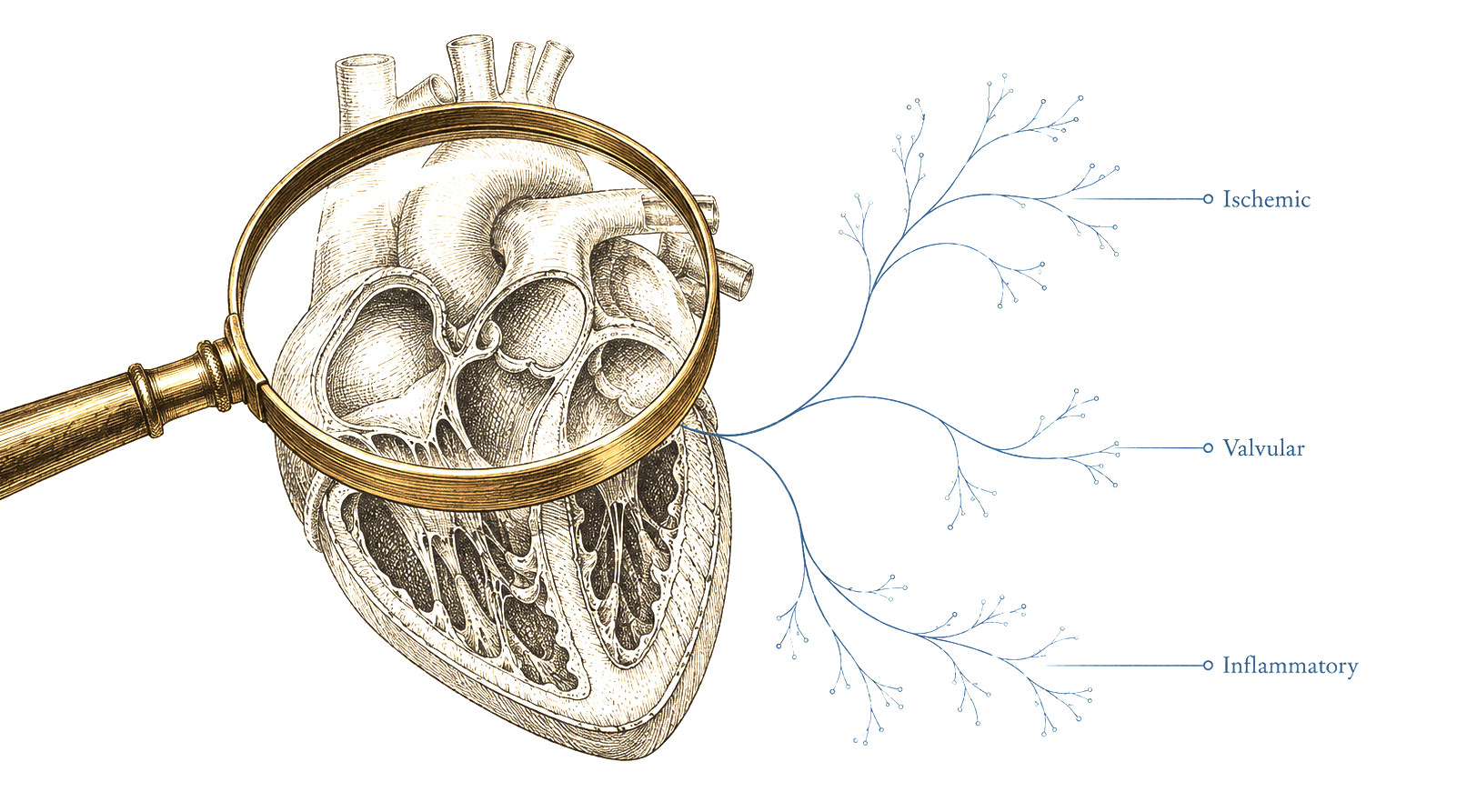
Editorial illustration: a magnifying glass over an anatomical heart, with a branching differential-diagnosis tree leading to ischemic, valvular, and inflammatory etiologies.

Healthleap

Healthleap logo
22/ 100

Evidence & Documentation Score

This legacy score reflects documented evidence, integrations, transparency, and market signals. It does not measure overall product performance. A new product-focused rating system is in development. How it is computed

reviewed November 2, 2026

Vendor
Healthleap, Inc., US
Pricing
No public price. Contract includes a 2:1 ROI floor on hard reimbursement, under which Healthleap pays back any shortfall.
EHR
Not stated
Compliance
HIPAA, SOC 2 Type II

Bottom line. Each morning, according to the vendor, Healthleap writes a malnutrition-risk score for every adult inpatient into the EHR flowsheet, giving dietitians a risk-sorted list of whom to assess first. One peer-reviewed validation exists, retrospective and indexed against discharge-coded malnutrition, with an AUROC of 0.92 on day 1 and four authors who work for the company. It fits a hospital whose… Read the full bottom line

Performance profile

  • Regulatory and compliance10 / 22
  • Clinical integration0 / 11.6
  • Evidence strength0 / 30
  • Vendor and market7.2 / 18
  • Sentiment and transparency1.3 / 2.5

Performance profile

  • Regulatory and compliance10 / 22
  • Clinical integration0 / 11.6
  • Evidence strength0 / 30
  • Vendor and market7.2 / 18
  • Sentiment and transparency1.3 / 2.5
On this page

All 10 dimensions

Regulatory and compliance

  • FDA clearance0 / 12

    No FDA clearance listed

  • HIPAA / SOC2 / BAA10 / 10

    HIPAA + (SOC2 or BAA) attested

Clinical integration

  • EHR integrations (count)0 / 5.6

    No EHR integrations listed

  • Top-3 EHR coverage (Epic / Oracle / Athena)0 / 4.8

    None of the top-3 EHRs covered

  • Bidirectional write-back0 / 1.2

    No bidirectional write-back documented

Evidence strength

  • Peer-reviewed papers0 / 21

    No peer-reviewed paper evaluating the product

  • RCT / meta-analysis / systematic review0 / 9

    No RCT, meta-analysis, or systematic review evaluating the product

Vendor and market

  • Funding & adoption signal3 / 12

    Seed-stage or unfunded

  • Years in market4.2 / 6

    Founded 2022 (4 years)

Sentiment and transparency

  • Pricing transparency1.3 / 2.5

    Pricing on request, no public amounts

Computed November 6, 2026 by our public rubric. How it’s computed

What it costs

From
No public price. Contract includes a 2:1 ROI floor on hard reimbursement, under which Healthleap pays back any shortfall.
Price points
1
Verified
November 2, 2026
Source
Vendor pricing page

All tiers are custom-quoted. The vendor does not publish per-provider list pricing.

TierMonthlyAnnualNotes
EnterpriseNot statedNot statedNo public price. Contract includes a 2:1 ROI floor on hard reimbursement, under which Healthleap pays back any shortfall.

Source: vendor pricing page. Last checked November 2, 2026.

Compliance

Attested
SOC 2 Type II, HIPAA
EHR integrations
Not stated
FDA
Not stated

Carries SOC 2 Type II, HIPAA per vendor documentation. Independent attestation review is the buyer's responsibility before clinical deployment.

Vendor stability

Company
Healthleap, Inc.
Headquarters
US
Founded
2022

Healthleap (Healthleap, Inc.) was founded in 2022 in US, putting it 4 years into market.

Vendor sitewww.healthleap.ai (opens in new tab)

Evidence record

RecordWhat we found
FDA decisions

No FDA decision cited in our research as of November 6, 2026.

Verification
  • Score computed November 6, 2026, method 1.2.1
  • Review written November 2, 2026
Cite this record

MedAI Verdict, Healthleap record, https://medaiverdict.com/tools/healthleap, version November 2, 2026

Change historyView every change to this record

Bottom line

Each morning, according to the vendor, Healthleap writes a malnutrition-risk score for every adult inpatient into the EHR flowsheet, giving dietitians a risk-sorted list of whom to assess first. One peer-reviewed validation exists, retrospective and indexed against discharge-coded malnutrition, with an AUROC of 0.92 on day 1 and four authors who work for the company. It fits a hospital whose nutrition team wants to prioritize assessments and capture malnutrition diagnoses. It covers adults only, so a pediatric service has no use for it, and the one validation is not independent.

Daily AI malnutrition-risk screening of adult inpatients, with a score written into the EHR flowsheet each morning.

No public price. Contract includes a 2:1 ROI floor on hard reimbursement, under which Healthleap pays back any shortfall. HIPAA + SOC 2 Type II attested.

How does the model work?

The validation paper describes a gradient-boosted decision tree model that uses a large language model for feature extraction. The vendor positions the score upstream of clinical documentation improvement and coding, and lists delirium and toxic metabolic encephalopathy, aspiration pneumonia, heart failure readmissions and pressure injuries as planned or adjacent screening areas.

The vendor refers only to "the EHR" and names none. It lists SOC 2 Type II and HIPAA compliance and makes no FDA claim, describing the product as clinical decision support and not a diagnostic tool.

What did the validation study show?

Bernstein and colleagues published it in Applied Clinical Informatics in 2025 (PMID 40523638). It used EHR data from 106,449 patients over 3.75 years. The AUROC was 0.92 (CI 0.91 to 0.92) on day 1 and 0.95 (CI 0.95 to 0.96) using the maximum risk during the stay, and the model outperformed the nurse-administered modified Malnutrition Screening Tool. Four authors are Healthleap employees and three are advisors. The vendor claims "88% higher sensitivity than nurse-administered screening".

What do hospitals report?

The vendor's evidence page gives deployment results. Penn Medicine's HUP shows an annualized impact of $23.8 million, made up of $6.3 million in reimbursement lift and $17.5 million from length of stay, plus a 21% year-over-year rise in malnutrition diagnoses and a 13% risk-adjusted length-of-stay improvement. Cedars-Sinai shows $11 million in annual impact and 39% more malnutrition diagnoses. The vendor publishes all of these figures.

The company and its contract

Healthleap, Inc. is based in San Francisco and was founded in 2022 by siblings Josiah Meyer, CEO, and Jemima Meyer, a clinician. The vendor states $38 million in combined seed and Series A funding from Sequoia Capital, First Round Capital and Hummingbird Ventures, with no date or lead shown. It says it screens every adult inpatient daily at more than 20 hospitals, naming Penn Medicine, Houston Methodist, Cedars-Sinai and Emory Healthcare, and calls itself, "to our knowledge", the only commercially available peer-reviewed AI malnutrition screening tool.

No price is public. The evidence page describes "a 2:1 ROI floor on hard reimbursement", under which Healthleap pays back any shortfall.

The verdict

It fits a hospital nutrition team that wants a daily risk-sorted list of adult inpatients to assess first, and the vendor's deployment figures concern malnutrition diagnoses, reimbursement and length of stay. It does not fit a pediatric service, since it screens adults only, or a committee that requires validation by authors outside the vendor, since four authors of the validation paper work for the company.

Editorial review last generated November 2, 2026. Synthesized from clinician sentiment, peer-reviewed coverage, and our editorial silo picks. Refined by hand where vendor facts change.


Link to this review

Healthleap, reviewed on MedAI Verdict

Vendors may place this badge on their own site. It links to this review with a tracking parameter and has no effect on the score.

<a href="https://medaiverdict.com/tools/healthleap?utm_source=vendor_badge&utm_medium=badge&utm_campaign=healthleap"><img src="https://medaiverdict.com/badges/reviewed-on-medaiverdict.png" srcset="https://medaiverdict.com/badges/reviewed-on-medaiverdict@2x.png 2x" alt="Healthleap, reviewed on MedAI Verdict" width="200" height="56"></a>

What we have not verified

  1. We have not run Healthleap in our own clinical practice. Pricing, certifications, and EHR-integration claims come from vendor documentation and have not been independently audited.
  2. Enterprise pricing tiers and SLA terms are typically under NDA and not publicly verifiable. Numbers shown reflect publicly disclosed self-service or list pricing only.
  3. Real-world latency, note quality, and accuracy in your specific specialty and patient population can vary materially from vendor demonstrations. We recommend a 30-day trial with two providers before commitment.

Last verified . Read our methodology · Decision support