- No public price.
- Not disclosed
- Not disclosed
- —
- —
Radiology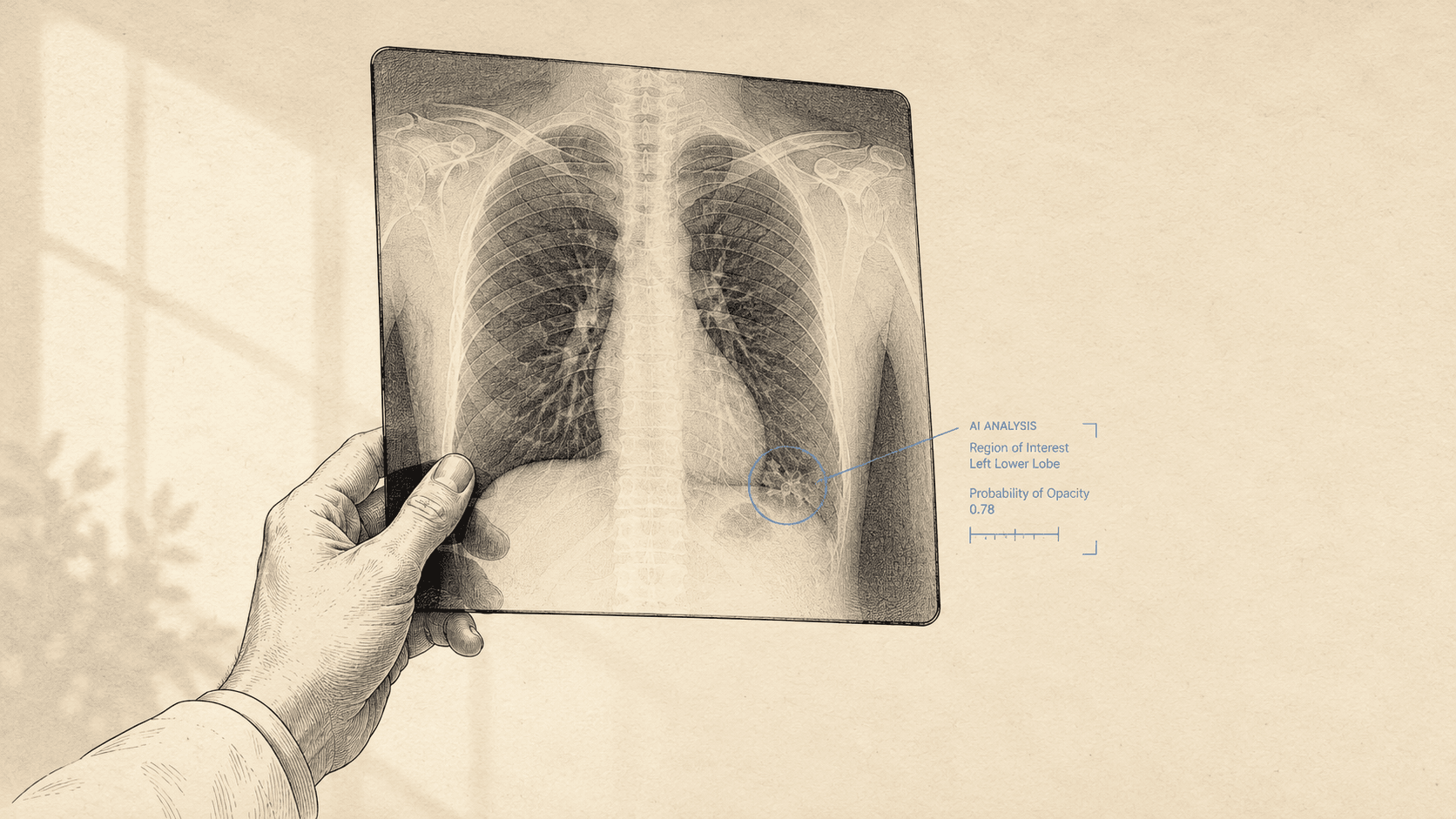

Nanox.AI
by Nano-X Imaging
CT AI for opportunistic screening: coronary calcium, vertebral fractures and liver fat on routine CT scans, for radiology departments.
On this page
35/100
Editorial rating 2.5 / 5
- Regulatory & Compliance18/28
FDA cleared (12 K-numbers on record)
- Clinical Integration0/6.6
No EHR integrations listed
- Evidence Strength0/26
No peer-reviewed coverage
- Vendor & Market8.4/18
Mid-tier funding and adoption
- Sentiment & Transparency2.5/5
Pricing on request, no public amounts
▸ Show all 11 dimensions▾ Hide dimension detail
- FDA clearance18/18
FDA cleared (12 K-numbers on record)
- HIPAA / SOC2 / BAA0/10
No public HIPAA/SOC2/BAA attestation
- EHR integrations (count)0/4
No EHR integrations listed
- Top-3 EHR coverage (Epic / Oracle / Athena)0/2
None of the top-3 EHRs covered
- Peer-reviewed papers0/18
No peer-reviewed coverage
- RCT / meta-analysis / systematic review0/8
No RCT, meta-analysis, or systematic review
- Funding & adoption signal8/12
Mid-tier funding and adoption
- Years in market0/6
Founded year not recorded
- Pricing transparency3/5
Pricing on request, no public amounts
CT AI for opportunistic screening: coronary calcium, vertebral fractures and liver fat on routine CT scans, for radiology departments.
No public price.
Evidence record
510(k)K241440 (opens in new tab)August 19, 2024
HealthCCSng
510(k)K233080 (opens in new tab)February 8, 2024
HealthFLD
510(k)K213944 (opens in new tab)April 22, 2022
HealthOST
510(k)K211803 (opens in new tab)December 15, 2021
HealthPPT
510(k)K210085 (opens in new tab)September 15, 2021
HealthCCSng
Show 7 more
510(k)K202487 (opens in new tab)December 4, 2020
HealthJOINT
510(k)K200905 (opens in new tab)July 16, 2020
HealthMammo
510(k)K192901 (opens in new tab)May 12, 2020
HealthVCF
510(k)K192320 (opens in new tab)November 26, 2019
HealthCXR
510(k)K190424 (opens in new tab)June 13, 2019
HealthICH
510(k)K190362 (opens in new tab)May 6, 2019
HealthPNX
510(k)K172983 (opens in new tab)June 13, 2018
HealthCCS
- Score computed November 2, 2026, method 1.2.0
- Review written November 2, 2026
MedAI Verdict, Nanox.AI record, https://medaiverdict.com/tools/nanox-ai, version November 2, 2026
Bottom line
Nanox.AI is a set of CT algorithms for opportunistic screening: they read scans acquired for other reasons and look for unrecognized chronic disease. The three products on the current AI page measure coronary calcium, vertebral height loss with bone density, and liver density. Radiology departments with heavy CT volume and a cardiac, bone or fatty-liver detection program are the audience. The older triage lines that appear in FDA records, such as pneumothorax and head hemorrhage triage, are absent from the current page, and whether they are still sold is not stated.
Whose name is on the FDA records?
The AI unit appears in FDA records as Zebra Medical Vision, Ltd. for 2018 to 2021, as Nanoxai, Ltd. in 2022 and as Nano-X AI, Ltd. in 2024. Whether Nanox acquired Zebra Medical Vision is unconfirmed. The Nasdaq-listed parent, Nano-X Imaging Ltd., files its hardware under a separate applicant, and those devices are not AI products.
What do the three tools measure?
HealthCCSng analyzes non-contrast, non-ECG-gated chest CT and measures calcified plaque in the coronary arteries, returning a calcium category. The vendor page ties the numerical score to the V.2 clearance. HealthOST detects vertebral height loss and measures bone mineral density on chest and abdominal CT. HealthFLD reports liver density in Hounsfield units on CT that covers a significant part of the liver, for fatty liver (MASLD/NAFLD) and MASH. According to the vendor, results go into the radiology report and the EMR.
How do the vendor's count and FDA's differ?
The AI page counts 7 FDA clearances and 2 CE Marks. FDA records show 12 AI decisions, from June 2018 to August 2024, filed under the three applicant names and including the older product lines. The current suite accounts for four of them: HealthOST in April 2022, HealthFLD in February 2024, and HealthCCSng in September 2021 and August 2024. The August 2024 decision covers routine non-gated, non-contrast CT in adults 30 to 85, with an exact calcium score and a four-category output.
What do the studies show?
A 2025 validation in Diagnostics (PMID 40564850) tested HealthOST for incidental vertebral compression fractures on outpatient chest and abdomen CT. Sensitivity was 92.0% at the 20% height-loss threshold, and the specificity figures in the abstract start at 52.7%. A 2025 BJR Artificial Intelligence paper (PMID 42064007) covers deploying the Nanox vertebral fracture solution in five NHS hospitals and concerns governance, not accuracy.
The vendor's AI page carries a case study from Corewell Health reporting nearly 4,000 new patients with coronary calcification in 2023, against 268 in the prior two years. It is vendor-published and not peer reviewed.
What does buying involve?
No public price. The AI page offers a meeting booking and a US Reimbursement Demo.
The verdict
The three current tools fit a radiology department that wants coronary calcium, vertebral height loss and liver density from CT it already acquires. A department after worklist triage for pneumothorax or head bleeds is outside what the current page lists.
Editorial review last generated November 2, 2026. Synthesized from clinician sentiment, peer-reviewed coverage, and our editorial silo picks. Refined by hand where vendor facts change.
What it costs
All tiers are custom-quoted. The vendor does not publish per-provider list pricing.
| Tier | Monthly | Annual | Notes |
|---|---|---|---|
| Enterprise | Not stated | Not stated | No public price. |
Source: vendor pricing page. Last checked November 2, 2026.
What deploys cleanly
Carries FDA 510(k), CE per vendor documentation. Independent attestation review is the buyer's responsibility before clinical deployment.
Other radiology
See the full radiology ranking
Siemens Healthineers AI-Rad Companion
by Siemens Healthineers
AI-Rad Companion: Chest CT, Chest X-ray, Brain MR, Prostate MR and Organs RT (radiotherapy contouring) modules, delivered through teamplay.
No public price on the vendor page.|FDA 510(k) (multiple) / CE Mark (MDD/MDR. MDR status not verified)
GE HealthCare AI Suite
by GE HealthCare
Portfolio of separately cleared AI-enabled GE HealthCare devices and software, including AIR Recon DL, Sonic DL, Critical Care Suite, Caption AI and icobrain.
No public price. Products are sold with scanners or as scanner options, on enterprise quotes.|FDA 510(k) (multiple)
Aidoc
by Aidoc
Clinical AI platform (aiOS) with FDA-cleared triage, notification and quantification algorithms for radiology and neurovascular care.
Private offer only. No trial is stated.|FDA 510(k) (multiple) / EU MDR 2017/745
Viz.ai
by Viz.ai
Care coordination platform with FDA-cleared imaging AI for stroke, vascular and cardiac conditions.
No public price. Sold to health systems after a demo request.|FDA 510(k) (multiple) / FDA De Novo (ContaCT, Viz HCM)