- No public price.
- Not disclosed
- Not disclosed
- —
- 2017
- LT
Radiology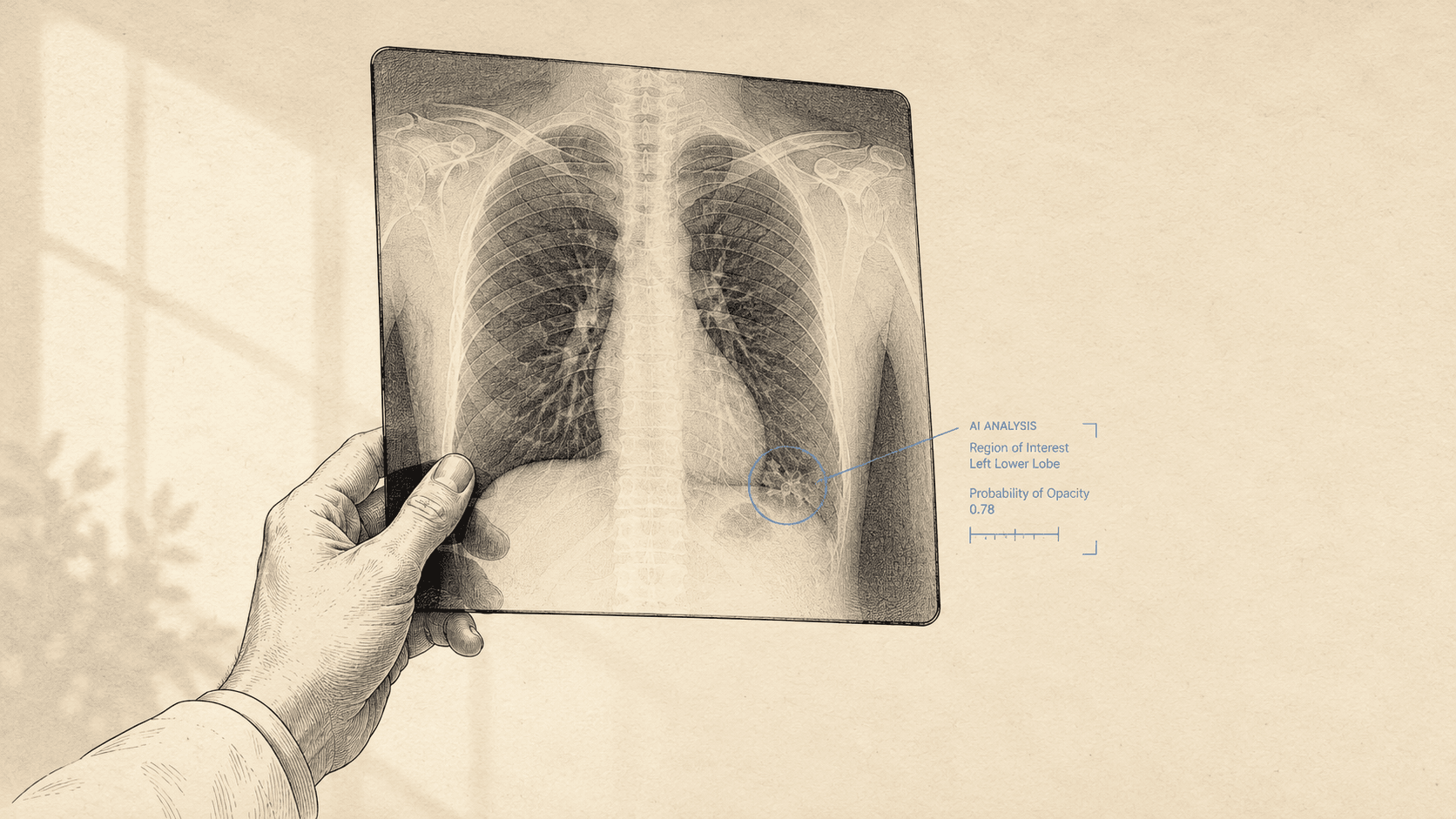
OX
Oxipit
by Oxipit · founded 2017 · LT
CE-marked AI (ChestLink) that autonomously reports normal chest X-rays without a radiologist. Now part of Sectra.
On this page
29/100
Not rated: too little independent evidence yet.
- Regulatory & Compliance0/28
No FDA clearance listed
- Clinical Integration0/6.6
No EHR integrations listed
- Evidence Strength12.7/26
2 peer-reviewed papers
- Vendor & Market9/18
Founded 2017 (9 years)
- Sentiment & Transparency2.5/5
Pricing on request, no public amounts
▸ Show all 11 dimensions▾ Hide dimension detail
- FDA clearance0/18
No FDA clearance listed
- HIPAA / SOC2 / BAA0/10
No public HIPAA/SOC2/BAA attestation
- EHR integrations (count)0/4
No EHR integrations listed
- Top-3 EHR coverage (Epic / Oracle / Athena)0/2
None of the top-3 EHRs covered
- Peer-reviewed papers13/18
2 peer-reviewed papers
- RCT / meta-analysis / systematic review0/8
No RCT, meta-analysis, or systematic review
- Funding & adoption signal3/12
Seed-stage or unfunded
- Years in market6/6
Founded 2017 (9 years)
- Pricing transparency3/5
Pricing on request, no public amounts
CE-marked AI (ChestLink) that autonomously reports normal chest X-rays without a radiologist. Now part of Sectra.
No public price.
Evidence record
No FDA decision cited in our research as of November 2, 2026.
2 studies on PubMed: 2 other, published 2022 to 2025. Read the literature summary
- Score computed November 2, 2026, method 1.2.0
- Review written November 2, 2026
MedAI Verdict, Oxipit record, https://medaiverdict.com/tools/oxipit, version November 2, 2026
Bottom line
Oxipit says ChestLink is the world's first CE Class IIb certified autonomous AI application for healthy chest X-ray reporting: it identifies normal studies and takes them off the radiologist's worklist. Sectra signed to acquire Oxipit in March 2026. ChestLink is CE marked, no Oxipit product appears in FDA's 510(k) records as of November 2026, and the vendor lists autonomous use as currently not available in the United States. European radiology groups with large volumes of primary-care chest films are the market.
What did the Oulu study measure?
The study cited on the vendor's page is a retrospective analysis at Oulu University Hospital of 9,579 primary-care chest X-rays (arXiv preprint 2205.08123). It is not peer reviewed, and Oxipit supplied the software. ChestLink flagged 1,692 studies as non-significant, which is 17.7% of all studies and 36.4% of the studies with no significant findings. The nine false negatives were slight cardiomegaly in four, slightly increased opacification in four and a small unilateral pleural effusion in one, and no lung masses, pneumothoraces or lobar consolidations were missed. The vendor's pages give the normal-study figure as 99.8% to 99.9%, labeled precision on the home page and sensitivity elsewhere.
What is ChestEye?
ChestEye received CE certification in 2019 and produces preliminary reports for 75 chest X-ray findings, with the radiologist staying in the loop. A 2025 retrospective study in Cureus (PMID 41116945) compared it with radiologists, with sensitivity ranging from 0.25 to 1.00 and specificity from 0.65 to 1.00 depending on the finding. A 2022 JMIR Research Protocols paper (PMID 36383419) is the protocol for a prospective validation, without results. No independent peer-reviewed validation of autonomous ChestLink was found in PubMed.
Where does Oxipit stand after the Sectra deal?
Sectra AB signed to acquire Oxipit on March 6, 2026, with terms undisclosed, and secondary sources report completion on April 15, 2026. Oxipit's team is to become an AI development center in Sectra's Imaging IT Solutions division. The company is based in Vilnius, Lithuania. It names Diagnostikum Group in Austria and German Medical Institute as customers and says the German deployment is integrated directly into the PACS workflow. Its regulatory page lists ChestLink as CE Class IIb from 2022, with TGA and Anvisa certificates also shown.
Is there a public price?
No public price. The contact page offers a demo request.
The verdict
A radiology group in a CE-regulated market that is ready to let software sign off normal chest films is the fit for ChestLink. In the Oulu data, ChestLink flagged 17.7% of the studies as non-significant. The vendor lists the autonomous mode as unavailable in the United States.
Editorial review last generated November 2, 2026. Synthesized from clinician sentiment, peer-reviewed coverage, and our editorial silo picks. Refined by hand where vendor facts change.
What it costs
All tiers are custom-quoted. The vendor does not publish per-provider list pricing.
| Tier | Monthly | Annual | Notes |
|---|---|---|---|
| Enterprise | Not stated | Not stated | No public price. |
Source: vendor pricing page. Last checked November 2, 2026.
What deploys cleanly
Carries CE per vendor documentation. Independent attestation review is the buyer's responsibility before clinical deployment.
Who builds it
Oxipit (Oxipit) was founded in 2017 in LT, putting it 9 years into market.
What the literature says
2 peer-reviewed studies indexed on PubMed evaluate Oxipit in clinical contexts. The most relevant are shown below, ranked by editorial relevance score combining title match, study design, recency, and journal tier.
- Evaluating the Diagnostic Accuracy of an Artificial Intelligence Tool for Pulmonary Abnormalities in Chest Radiographs: A Retrospective Study. (opens in new tab)
- Gobira M, Moreira do Amaral MD, Landi Júnior O, et al.· Cureus· 2025
- Introduction A retrospective, in-clinic study was conducted to validate the diagnostic performance of the Oxipit ChestEye™ AI tool in interpreting chest radiographs and to evaluate its impact on clinical outcomes and healthcare system efficiency. The performance of the AI model was compared with that of radiologists. Methods Chest radiographs from 1,470 patients, obtained from a public healthcare institution, were analyzed for nine pulmonary conditions: consolidation, heart enlargement, interstitial markers, linear atelectasis, no cardiopulmonary findings, nodule, pleural effusion, pne…
- Developing an Artificial Intelligence Model for Reading Chest X-rays: Protocol for a Prospective Validation Study. (opens in new tab)
- Miró Catalina Q, Fuster-Casanovas A, Solé-Casals J, et al.· JMIR Res Protoc· 2022
- Chest x-rays are the most commonly used type of x-rays today, accounting for up to 26% of all radiographic tests performed. However, chest radiography is a complex imaging modality to interpret. Several studies have reported discrepancies in chest x-ray interpretations among emergency physicians and radiologists. It is of vital importance to be able to offer a fast and reliable diagnosis for this kind of x-ray, using artificial intelligence (AI) to support the clinician. Oxipit has developed an AI algorithm for reading chest x-rays, available through a web platform called ChestEye. This platf…
Other radiology
See the full radiology ranking
Siemens Healthineers AI-Rad Companion
by Siemens Healthineers
AI-Rad Companion: Chest CT, Chest X-ray, Brain MR, Prostate MR and Organs RT (radiotherapy contouring) modules, delivered through teamplay.
No public price on the vendor page.|FDA 510(k) (multiple) / CE Mark (MDD/MDR. MDR status not verified)
GE HealthCare AI Suite
by GE HealthCare
Portfolio of separately cleared AI-enabled GE HealthCare devices and software, including AIR Recon DL, Sonic DL, Critical Care Suite, Caption AI and icobrain.
No public price. Products are sold with scanners or as scanner options, on enterprise quotes.|FDA 510(k) (multiple)
Aidoc
by Aidoc
Clinical AI platform (aiOS) with FDA-cleared triage, notification and quantification algorithms for radiology and neurovascular care.
Private offer only. No trial is stated.|FDA 510(k) (multiple) / EU MDR 2017/745
Viz.ai
by Viz.ai
Care coordination platform with FDA-cleared imaging AI for stroke, vascular and cardiac conditions.
No public price. Sold to health systems after a demo request.|FDA 510(k) (multiple) / FDA De Novo (ContaCT, Viz HCM)